
How to organize a beach volleyball league: matchdays, schedule and standings
A beach volleyball league (for example, a summer league that plays one afternoon a week on the sand) lasts weeks or months, so the hard part is not starting it but keeping the schedule, the results and the standings up to date without going crazy. This is what you need to decide and how to avoid endless spreadsheets.
1. Define the format of the league
- Single round robin: each team plays every other team once. With 8 teams that is 7 matchdays.
- Double round robin: home and away, fairer because each team faces every rival twice. It doubles the length.
- Regular phase + final phase: after the matchdays, the best-ranked teams play a knockout to decide the champion. It keeps interest up until the end.
With an odd number of teams, one team rests in each matchday. It is best to distribute those rests evenly.
2. Set the rules before you start
Write down and share with all the teams:
- How many sets are played and to how many points (in beach volleyball, the usual is 21 points and a third set to 15).
- How many standings points each result gives (for example, different if the match ends 2-0 or 2-1).
- The tiebreak order.
- What happens if a team does not show up or asks to postpone a match.
3. Build the matchday schedule
With many teams, generating by hand a schedule in which nobody repeats an opponent or plays twice in a row on the same day is tedious and error-prone. It is best to use a tool and leave room for postponements.
Example: schedule of a 6-team league
With 6 teams (A, B, C, D, E and F) in a single round robin there are 5 matchdays of 3 matches each, that is, 15 matches in total (the formula is teams × (teams − 1) ÷ 2). You need 3 sand courts at the same time, or play the 3 matches of each matchday one after another. This schedule was made with the so-called circle method: one team stays fixed and the others rotate one position in each matchday.
| Matchday | Match 1 | Match 2 | Match 3 |
|---|---|---|---|
| 1 | A – F | B – E | C – D |
| 2 | A – E | F – D | B – C |
| 3 | A – D | E – C | F – B |
| 4 | A – C | D – B | E – F |
| 5 | A – B | C – F | D – E |
Check that each team plays exactly once per matchday and that nobody repeats an opponent: A faces F, E, D, C and B, in that order, and the same happens with the others. If the league is a double round robin, you repeat the five matchdays in the same order as matchdays 6 to 10.
With an odd number of teams
With 5 teams the trick is the same: add an imaginary team and whoever plays against it rests that matchday. Removing team F from the previous schedule leaves this:
| Matchday | Match 1 | Match 2 | Rests |
|---|---|---|---|
| 1 | B – E | C – D | A |
| 2 | A – E | B – C | D |
| 3 | A – D | E – C | B |
| 4 | A – C | D – B | E |
| 5 | A – B | D – E | C |
That is 5 matchdays with 2 matches each, and each team rests only once. That way nobody plays more matches than another or is left without playing for several weeks in a row.
What to check before approving the schedule
- Room for postponements: leave free matchdays at the end or a catch-up date.
- The weather: on the beach, wind, rain or heat force you to postpone matchdays more often than in a sports hall, so allow for it.
- Awkward times: if a team cannot play on a specific day, you have to move matches without breaking the order of opponents.
- The last matchdays: if a team rests precisely in the last one, it may arrive with an advantage or disadvantage compared with the rest. Check that this rest does not decide the title.
4. Keep the standings up to date
The standings usually include matches played, won, lost and standings points, plus the set and point ratios to break ties. If you calculate them by hand, a mistake in one matchday carries over to the rest of the league.
5. Let the teams see the schedule without asking you
In a long league, the most repeated question is "when do I play?". If players can carry the schedule on their phone and check the standings at any time, you save most of the messages.
How VolleyLeku solves it
VolleyLeku generates the league, the schedule and the standings from the teams you enter, and keeps them up to date every time you enter a result.
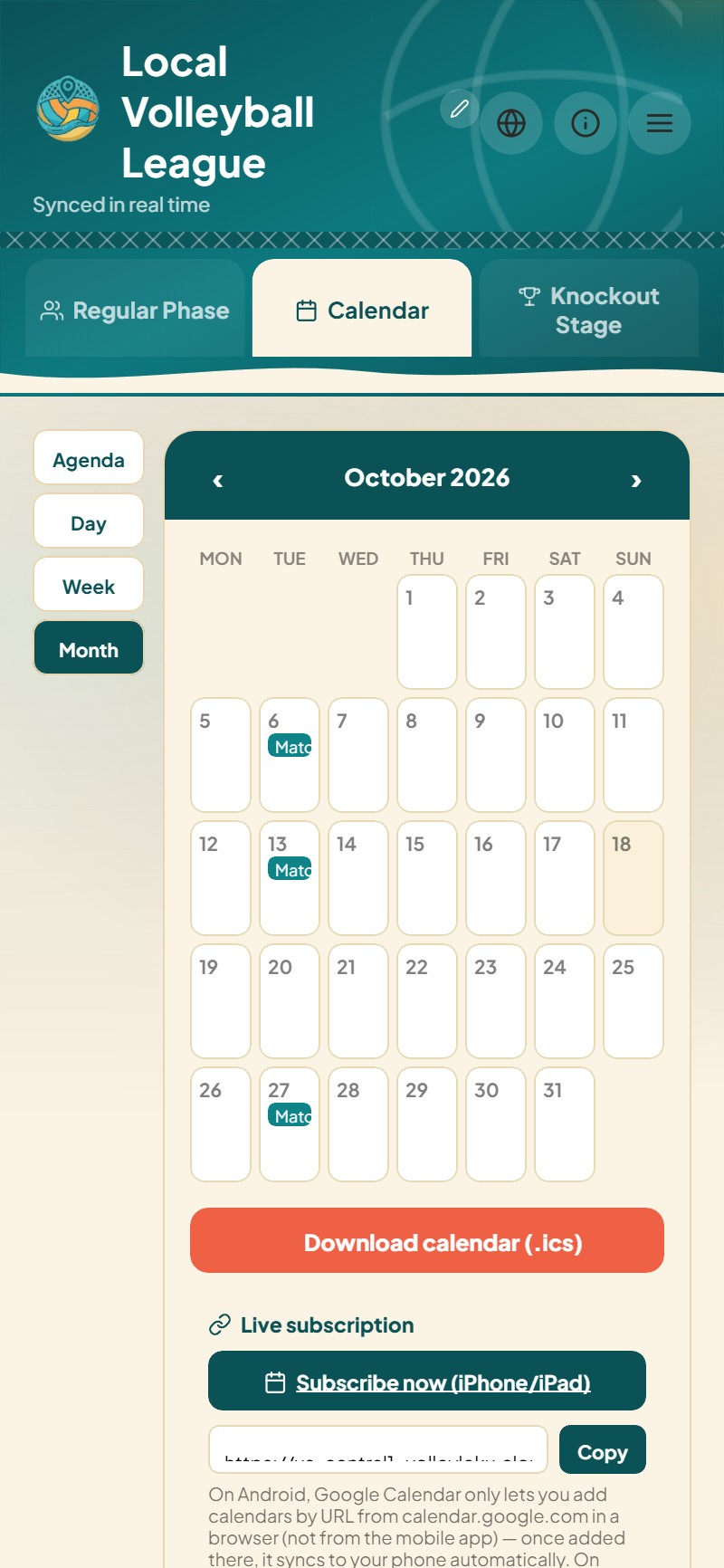
- Schedule with agenda, day, week and month views.
- Downloadable schedule (.ics) and live subscription from your phone.
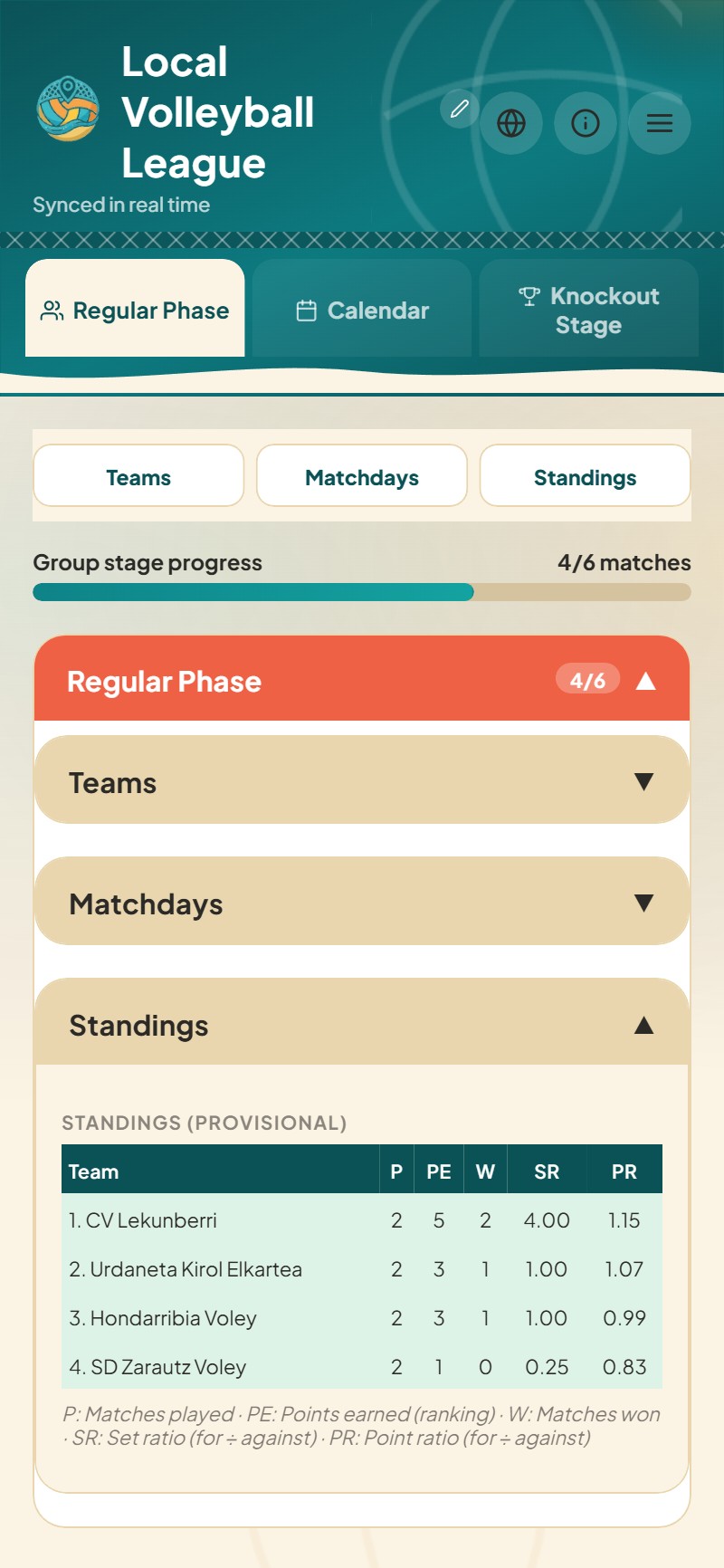
- Automatic standings with matches played, won, and set and point ratios.
- Regular phase and knockout phase in the same competition.
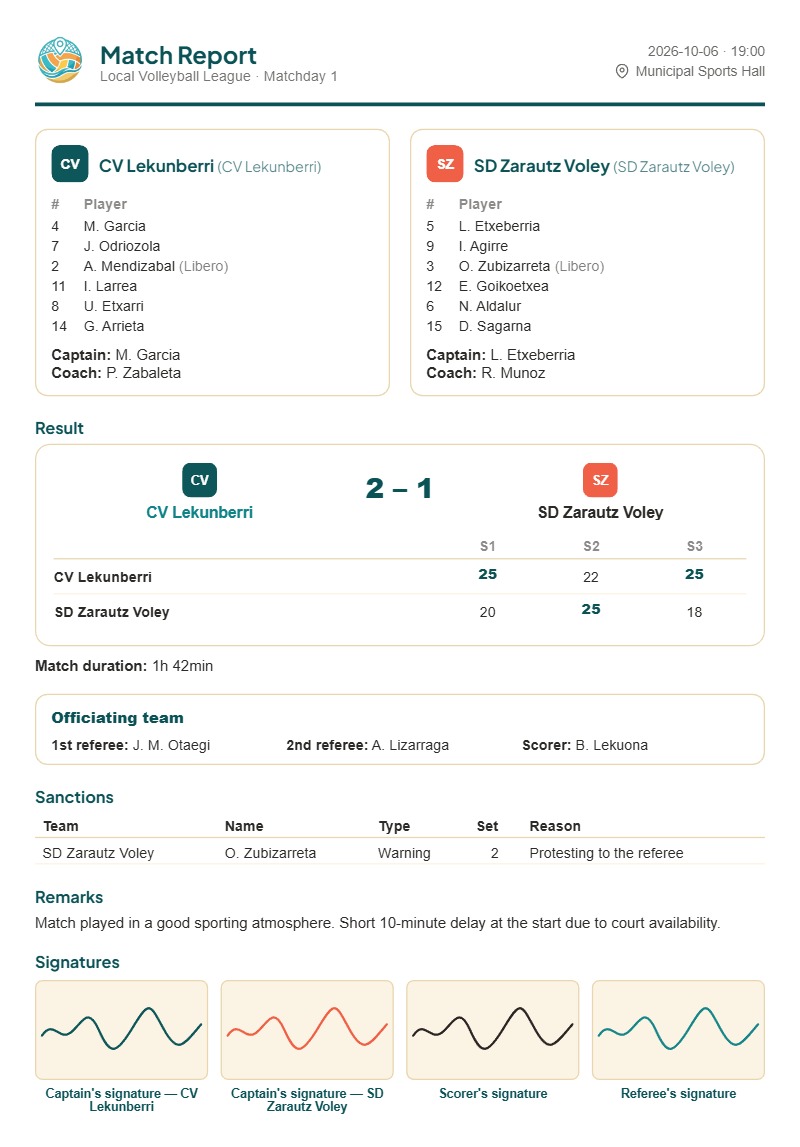
- PDF match scoresheets with line-ups, set-by-set result and signatures.
- Link for participants, with no sign-up or installation.
- Up to 2 collaborators and sponsor logos with links.
Frequently asked questions
How many matchdays does a volleyball league have?
In a single round-robin league, with N teams there are N-1 matchdays if N is even (N if it is odd, because one team rests in each matchday). In a double round robin, twice that.
How many matches does a volleyball league have?
In a single round-robin league there are teams × (teams − 1) ÷ 2 matches. With 6 teams that is 15 matches, spread over 5 matchdays of 3 matches. In a double round robin, twice that.
How are ties broken in a volleyball league?
The usual order is by standings points, then by matches won, then by set ratio and finally by point ratio. The important thing is to set the criterion and communicate it before the first matchday.
Can players carry the schedule on their phone?
Yes. In VolleyLeku the schedule can be downloaded in .ics format or subscribed to live from your phone's calendar.
Can the league end with a final phase?
Yes. Many leagues have a regular phase and then a knockout phase between the best-ranked teams. In VolleyLeku the competition includes a regular phase and a knockout phase.
Need a blank scoresheet to print? There is a ready-to-use volleyball scoresheet template.
Prefer a one-day event? Read how to organize a beach volleyball tournament step by step.
Manage your league without spreadsheets
Create your beach volleyball league and share the link with the pairs and teams.
Get started with VolleyLeku