
How to organize a beach volleyball tournament step by step
Organizing a beach volleyball (or grass volleyball) tournament comes down to choosing a format, splitting the pairs or teams, building a schedule and keeping the standings up to date. Here is the order in which it is best to do it and how to save yourself the heaviest work.
1. Decide how many pairs and how many courts you have
Everything else depends on these two numbers: how many pairs (or teams) sign up and how many sand courts you have set up. The length of a match depends on how many sets you play and to how many points (measure how long yours take in the first round and adjust). In beach volleyball it is usual to play to 21 points, and a single-set match to 21 is much shorter than a best-of-three (21, 21 and 15). Divide the available hours by the length of a match and you will know how many matches fit in the day. If you play in the sun, also leave room for breaks and for drinking water.
- Few pairs (for example, 4 to 6): round robin in a single group.
- A medium number (for example, 8 to 16 pairs): several groups and a final phase.
- Many pairs: more groups, or a final phase by categories (gold, silver and bronze) so that nobody goes home after two matches.
2. Choose the tournament format
Group stage + final phase
The most balanced format for amateurs: everyone plays several guaranteed matches and the best of each group meet afterwards. It is the one most used in beach volleyball tournaments.
Double elimination
Very common on sand: a pair is not out until it loses two matches, so nobody travels to the beach to play just once. It lasts a bit longer than single elimination, but it is much more enjoyable.
Single elimination
It is the fastest, but a single bad match puts you out. Use it only if you are short on time or have many pairs and few courts.
Swiss system
Everyone plays the same number of rounds and in each one teams are paired with similar balance. It is the option when there are many pairs and few courts. Here we explain how it works.
League
Everyone plays everyone over several matchdays or weeks. It is the typical format of club leagues, summer beach leagues or groups of friends who meet every week.
King of the Court
A round-based mode designed for individual players who rotate partners, or for fixed pairs. It is a beach volleyball classic and works very well at social events. Here we explain how it is played and how to organize it.
The formats you can choose in VolleyLeku
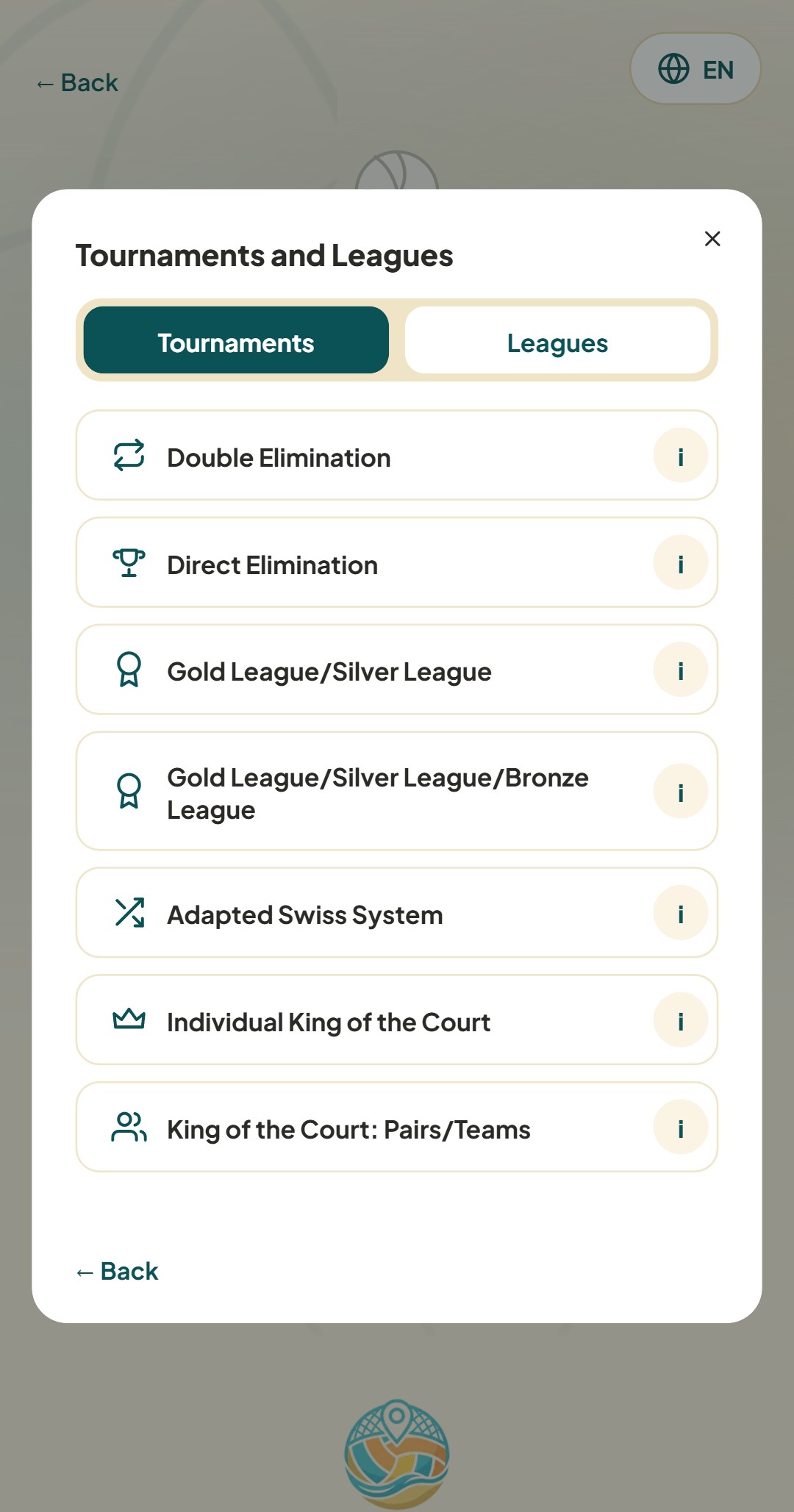
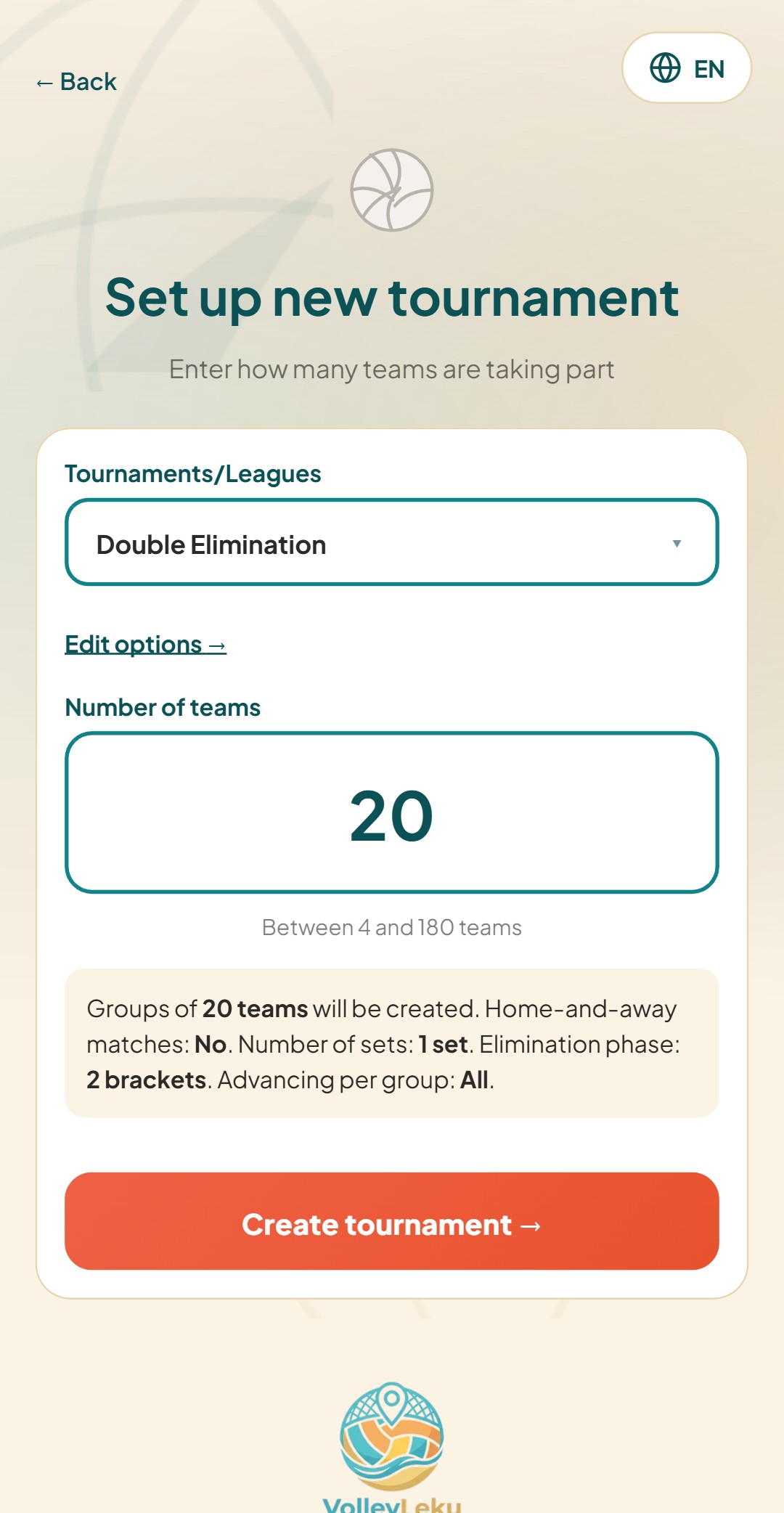
When you create a tournament you choose among ready-made formats: Double Elimination, Single Elimination, Gold/Silver League, Gold/Silver/Bronze League, Adapted Swiss System and King of the Court (individual or pairs/teams). With the "i" button on each one you can see how it works before deciding. Then you say how many teams take part (between 4 and 180) and, with "Edit options", you adjust the details of the chosen format.
3. Split the pairs into groups
Try to make the groups the same size and, if you know the level of the pairs, to keep the two best pairs out of the same group. If there is no way of knowing, hold a draw (on the sand, in front of everyone, it works well) and make it clear from the start how it was done.
4. Build the schedule
This is where most time is lost. You have to avoid a pair playing two matches in a row without rest (on sand and in the heat you really notice it), distribute the courts and leave slots for the final phase. If you do it by hand, start with the final phase and work backwards.
5. Define the ranking criteria
Decide before you start what happens in case of a tie. The usual way is to rank by matches won, then by set difference and finally by point difference. If you announce it before the first match you save yourself arguments at the end.
6. Keep the results visible to everyone
Players want to know what time they play and how things are going. A sheet of paper stuck on a wall is out of date within half an hour. Sharing a link with the standings and the schedule always up to date stops people asking you every five minutes.
How VolleyLeku solves it
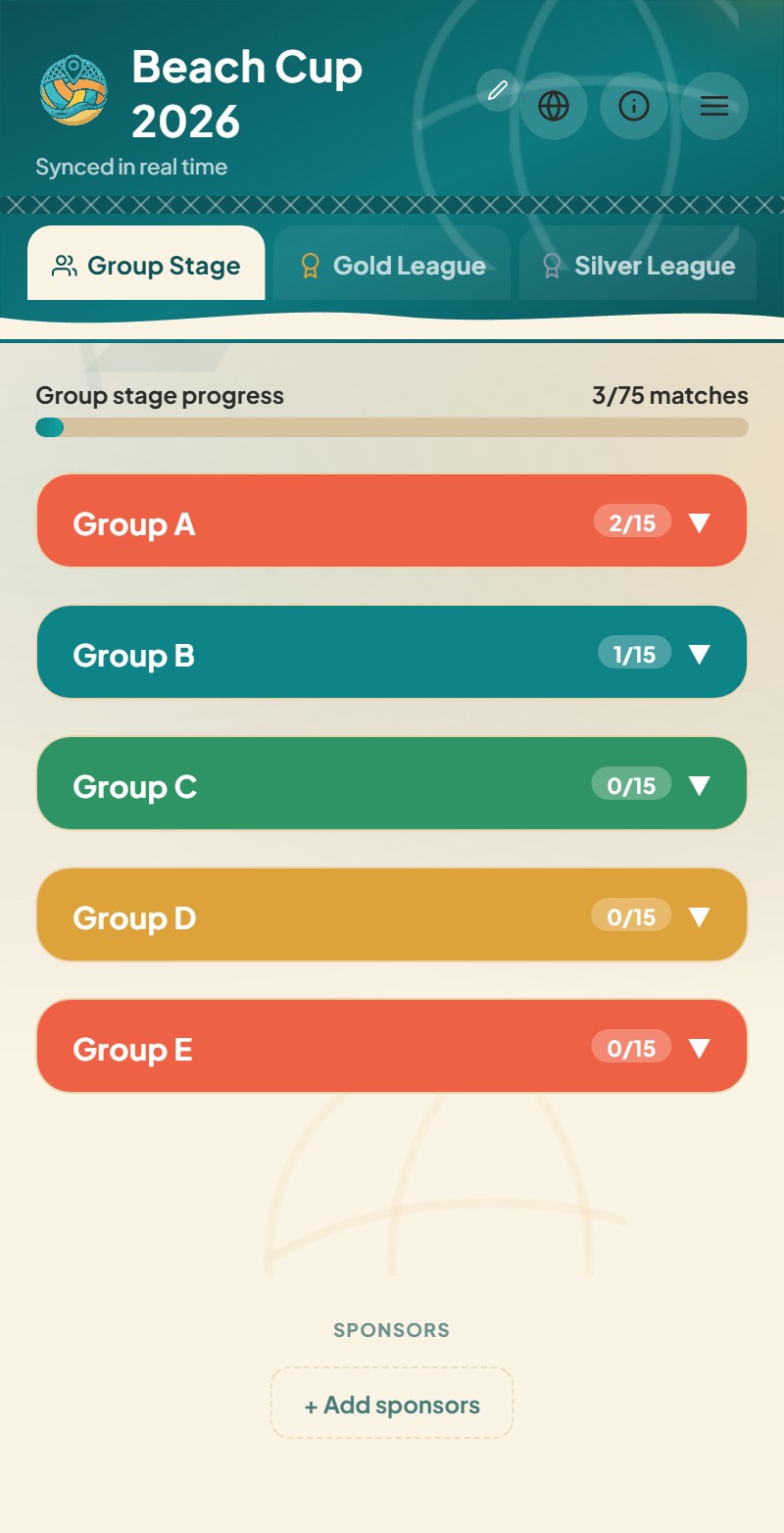
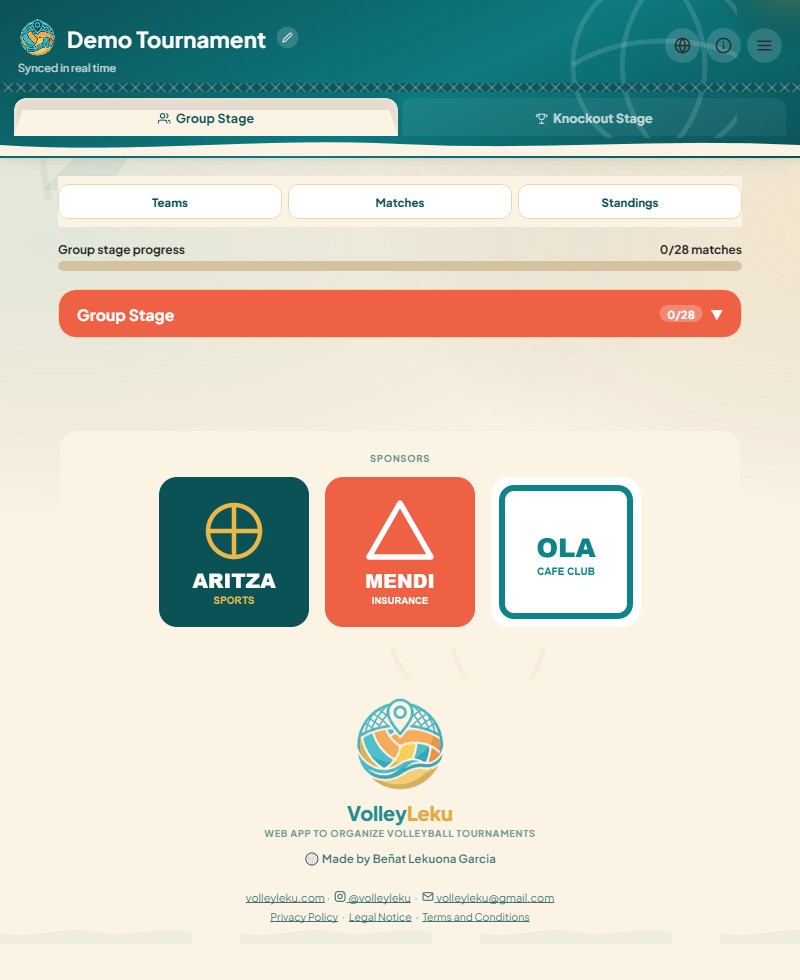
VolleyLeku is a web app that does steps 3 to 6 for you. You choose a ready-made tournament or league, or customize them, enter the pairs or teams and the app generates the groups, the schedule and the standings.
- Automatic groups, schedule and standings, updated each time you enter a result.
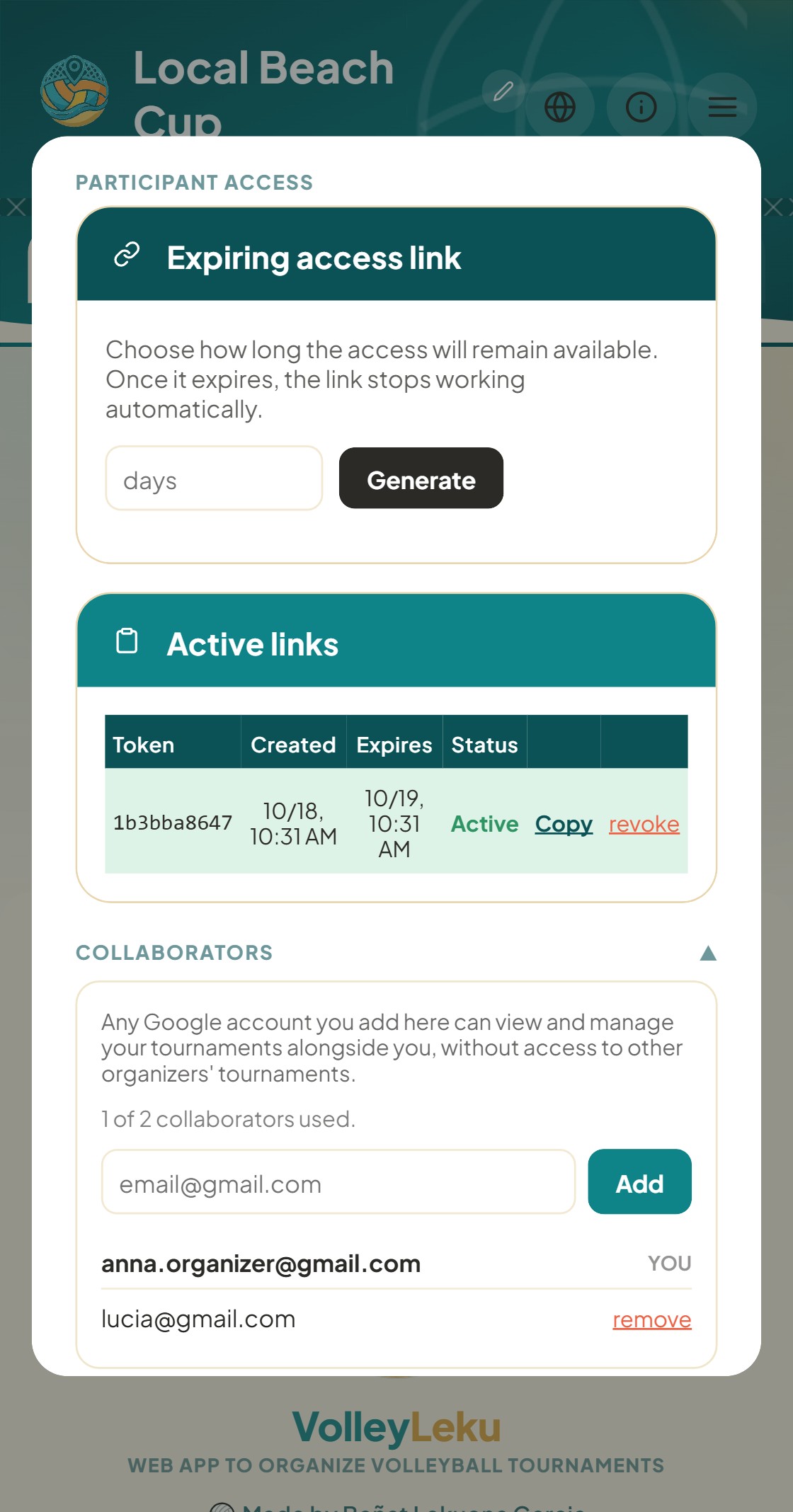
- Real-time results for anyone with the link, with no sign-up or installation.
- Up to 2 collaborators who help you run the tournament with you.
- Sponsor logos linking to their website.
- Up to 180 teams in a single tournament or league.
Frequently asked questions
How many pairs or teams can a beach volleyball tournament have?
It depends on the sand courts you set up and the time you have. As a guide, a one-day tournament works well with about 6 to 16 pairs; with more, it is best to split into groups and play a final phase. In VolleyLeku you can enter up to 180 teams or pairs in a single tournament or league.
Which format is best for an amateur beach volleyball tournament?
A group stage followed by a final phase is the most balanced: all pairs play several matches and the best ones meet afterwards. Double elimination also works very well on sand, because nobody goes home after losing a single match. Single elimination is shorter but knocks out half the field early.
Do participants have to sign up or download an app?
No. They access it from the link you share, straight from the browser on their phone or computer, with no sign-up or installation.
Can results be followed live?
Yes. As soon as the organizer enters a result, anyone with the link sees it instantly, without reloading the page.
Setting up a pairs tournament on the sand? See the guide to the 2x2 beach volleyball tournament. Looking for something longer, over several weeks? Read how to organize a volleyball league.
Organize your first tournament in minutes
Create your beach volleyball tournament and share the link with the participating pairs.
Get started with VolleyLeku