
King of the Court in beach volleyball: how it is played and how to organize it
King of the Court is a beach volleyball classic: a dynamic format in which everyone plays a lot and nobody waits for hours for their turn. It is ideal for events on the sand, amateur tournaments and club days. Here is how it works, how it is scored and how to organize it without getting lost in the rotations.
How it works
On each sand court (which in VolleyLeku we call a court) there is a King team on one side, and other teams waiting in a queue to challenge it. In each match:
- The King faces the first challenger in the queue.
- If the King wins, they stay on their side. If the challenger wins, they are crowned and become the new King.
- The team that loses goes to the back of the queue and the next challenger steps onto the court.
Points are earned for being on the King's side and for winning matches. Whoever has the most at the end of the rounds wins.
Two modes: individual and pairs or teams
Individual King of the Court
Each player signs up on their own and competes with a different partner in every match. It is perfect for groups with no fixed teams, because everyone plays with everyone and whoever scores the most points wins individually. In VolleyLeku the King and challenger pairs are formed automatically from whoever is waiting in the queue, and repeating partners is avoided whenever possible.
King of the Court for pairs or teams
The teams come already formed and do not change members during the tournament. You only register the name of each pair or team. It is the usual mode in pairs (2x2) beach volleyball tournaments.
How scoring works in VolleyLeku
- 3 points for a win, 1 point for a draw and 0 points for a loss.
- Points add up across all courts and rounds.
- Tiebreaker: first the ratio (points earned ÷ matches played), then total points and, if still tied, a fixed draw.
- A match ends by time or by points, whichever comes first. That keeps the pace up and stops a court from getting stuck.
- The King is dethroned by losing or by winning too many matches in a row, so that the crown keeps moving.
The problems of organizing it by hand
King of the Court is fun to play, but hard to organize with pen and paper:
- Participants have to be split into several courts of similar size.
- You have to keep the queue of each court, and make sure the same people do not always play.
- Between rounds you have to reshuffle the courts, trying not to repeat partners.
- You have to add up the points of all courts and decide who goes through to the final phase.
How VolleyLeku solves it
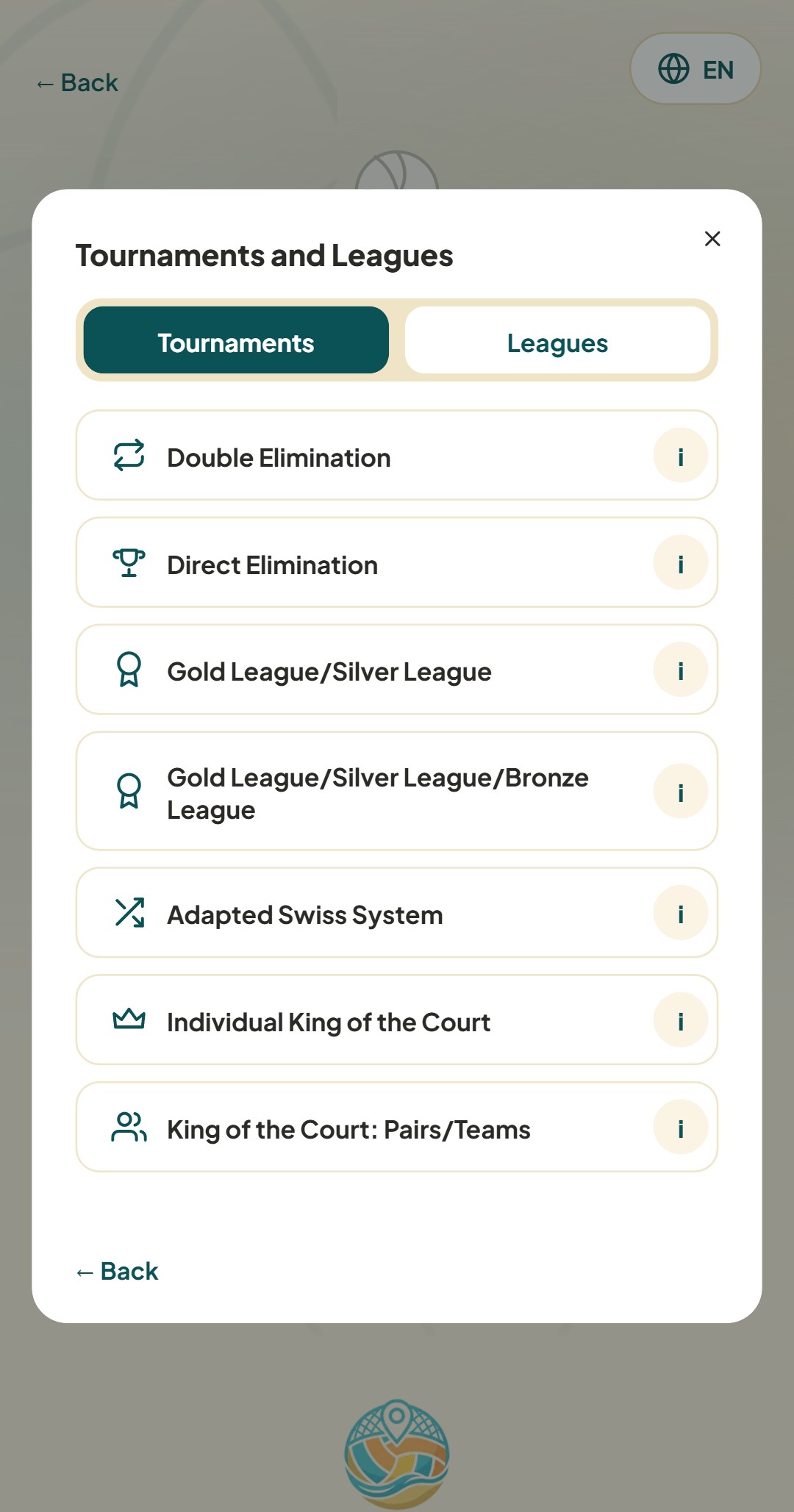
In VolleyLeku's format picker you will find King of the Court: Individual and King of the Court: Pairs/Teams. With the "i" button on each one you can see how it works before choosing it.
- Automatic split into courts: you say how many courts you want and the app distributes the participants.
- Balanced waiting queue: whoever has played the fewest matches goes in first, so that playing time is shared equally.
- Reshuffling between rounds: the courts are regrouped, avoiding repeated partners whenever possible.
- Automatic overall ranking, with the points of all courts added together.
- Final phase between the best-ranked players to decide the champion.
- Live results for participants from a link, with no sign-up or installation.
Frequently asked questions
What is King of the Court in beach volleyball?
It is a game format in which one team, the King, defends its side of the court against challenging pairs or teams waiting in a queue. Whoever wins stays or is crowned; whoever loses goes back to the queue. The winner is whoever collects the most points while on the King's side.
Can King of the Court be played individually?
Yes. In individual mode each player signs up on their own and plays with a different partner in every match. VolleyLeku forms the pairs automatically, avoiding repeated partners whenever possible.
How many players or teams are needed?
In VolleyLeku you need at least 4 participants. They are split into one or several independent courts, each with its own King and waiting queue.
How is the champion decided?
After the rounds of the regular phase, the points of all courts are added up and the best-ranked players play a Final Phase that decides the champion.
If you prefer another format, read the guide to the 2x2 pairs tournament, how to organize a beach volleyball tournament step by step or how to organize a volleyball league. If you have many pairs and few courts, also look at the Swiss system.
Organize your King of the Court without the headaches
Create your individual or pairs tournament and share the link with the players.
Get started with VolleyLeku