
Swiss system in beach volleyball: how it works, how many rounds you need and when to use it
The Swiss system was born in chess and is ideal when you have many pairs, few courts and you want nobody to go home after losing a single match. In beach volleyball it works very well in weekend tournaments, where every sand court has to work all day. Here is how pairing works, how many rounds are worth playing and its limits.
What the Swiss system is
In a Swiss system there are no groups or elimination in the regular phase. All teams play the same number of rounds, and in each round they are matched with opponents who have a similar record. Whoever wins moves up the table and faces others who also win; whoever loses moves down and plays others who have also lost. That way, round after round, the best gather at the top and the table sorts itself out without anyone playing everyone.
How teams are paired: an example with 8 teams
The first round is paired at random or by level, because there are no standings yet. From the second round on, each round follows the standings: 1st against 2nd, 3rd against 4th, and so on. If two teams have already met, the next possible opponent is used.
| Round | Pairings (by standings) |
|---|---|
| 1 | Initial pairing (draw or by level): 4 matches among the 8 teams |
| 2 | The table is sorted: 1st vs 2nd, 3rd vs 4th, 5th vs 6th, 7th vs 8th |
| 3 | It is re-sorted with the new results and repeated, avoiding repeated opponents |
After each round, the standings are updated and the next pairing depends on the previous result. That is why the matches of the last rounds are usually the most evenly matched.
How many rounds you need
A practical rule is to use as many rounds as the base-2 logarithm of the number of teams, rounded up. With that number of rounds, there is, in theory, a single unbeaten team.
| Teams | Recommended minimum rounds |
|---|---|
| 8 | 3 |
| 16 | 4 |
| 32 | 5 |
| 64 | 6 |
You can play more rounds to refine the standings, but you gain little: the important thing is not to fall short. And the maximum possible is one less than the number of teams, because beyond that you would have to repeat opponents.
Advantages and limits
When it is a good idea
- Many pairs and few courts: each team plays a fixed, predictable number of matches.
- Nobody is knocked out early: everyone plays every round, which keeps the atmosphere up at amateur events.
- Evenly matched games: from the second round you face teams of your level.
- A single weekend: the number of rounds is short and manageable.
Its limits
- Not everyone plays everyone: with few rounds there can be ties at the top. That is why it is best to finish with a knockout phase among the best.
- It is hard to run by hand: you have to re-sort and pair after every round, and check that opponents are not repeated.
- Teams do not know their opponent until the previous round ends, so the schedule cannot be published all at once.
Swiss system compared with other formats
| Swiss system | Group stage | Single elimination | |
|---|---|---|---|
| Matches per team | Fixed (the rounds) | Fixed (the group) | Variable, minimum 1 |
| Teams knocked out early | No | No | Yes, half of them in round 1 |
| Schedule known in advance | No, it depends on results | Yes | Only round 1 |
| Best for | Many pairs, few courts | Mid-sized fields and several courts | Little time |
How VolleyLeku solves it: Adapted Swiss System
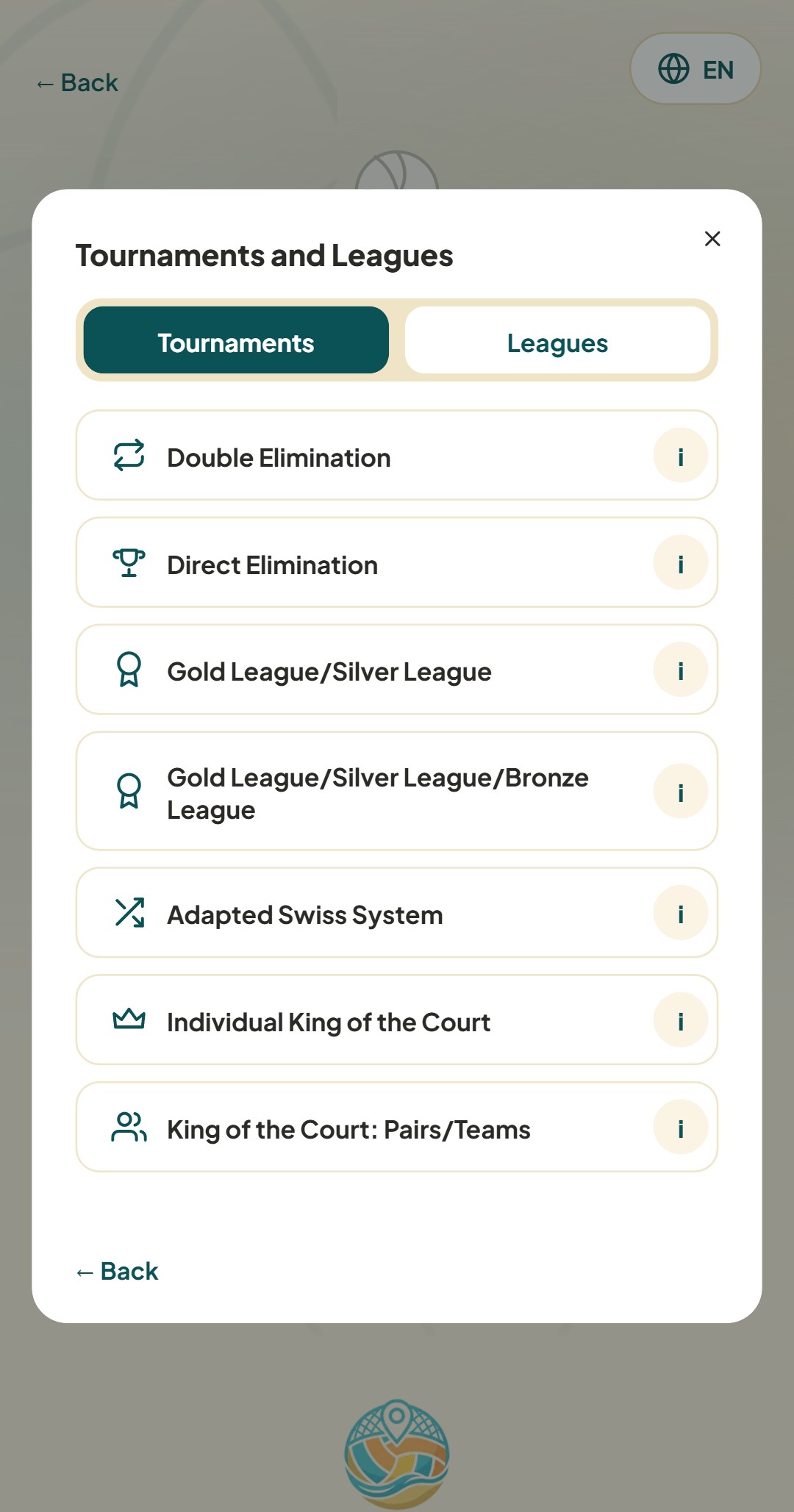
In VolleyLeku you will find the Adapted Swiss System in the format picker. It is suitable for large one-weekend tournaments and is adapted to volleyball so that it is easy to run:
- A single standings table, sorted by matches won, points ratio (points for ÷ points against), head-to-head and a draw in case of a tie.
- Automatic pairing after each round: 1st against 2nd, 3rd against 4th, skipping to the next one if they have already met.
- Matches of 1 set to 21 points, so that rounds are short.
- Number of rounds of your choice in the regular phase, with 5 by default.
- Knockout phase afterwards: depending on the final position, teams move on to the knockout format you choose, and you decide how many advance.
- Up to 180 teams and live results for all participants from a link, with no sign-up or installation.
Frequently asked questions
What is the Swiss system in a beach volleyball tournament?
It is a format in which all teams play the same number of rounds without being eliminated. In each round teams are paired with a similar record, so the best end up facing each other.
How many rounds does a Swiss system need?
A usual rule is to use as many rounds as the base-2 logarithm of the number of teams, rounded up: 3 rounds for 8 teams, 4 for 16, 5 for 32. With fewer rounds there can be several teams tied at the top; with more, the ranking improves little.
Can a team play the same opponent twice?
In a Swiss system it should not. When pairing, if two teams have already met, the next possible opponent is used. In VolleyLeku the app does it automatically.
Does the Swiss system work if I do not have many courts?
Yes, it is precisely one of its strong points: with few courts and many pairs, each team plays a fixed number of short matches and nobody is knocked out early.
Other formats: the guide to the 2x2 pairs tournament, King of the Court, volleyball league and the general guide to organizing a tournament.
Set up your Swiss tournament without working out pairings
Choose Adapted Swiss System, enter the teams and the app pairs each round.
Get started with VolleyLeku